
Artists
A Tribute to Every Drummer Who Powered the AC/DC
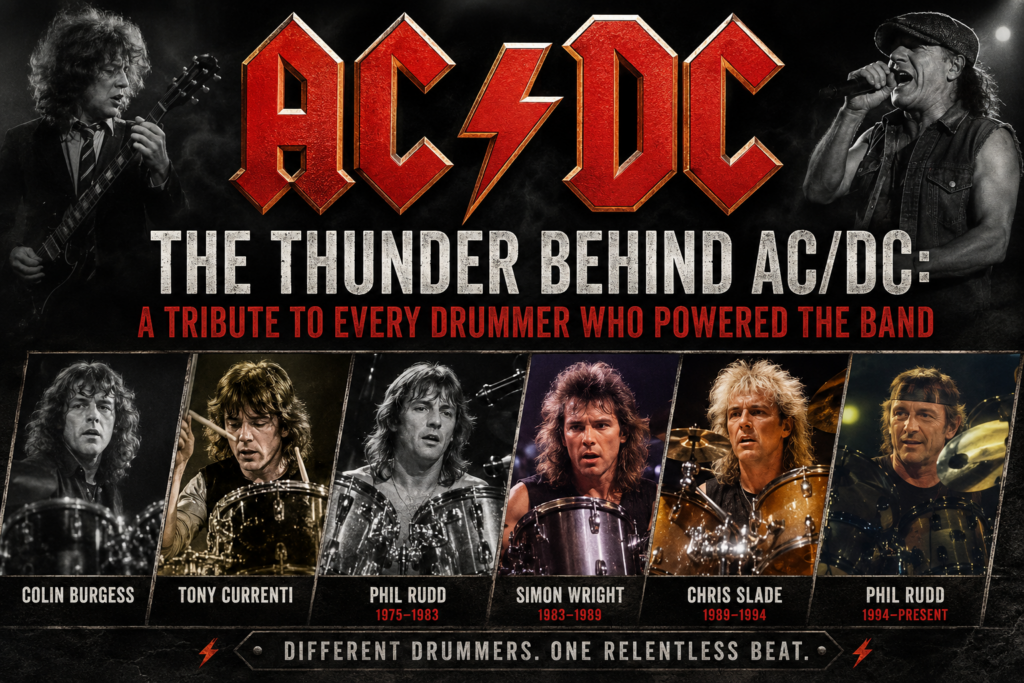
Few rock bands in history have delivered raw power and consistency quite like AC/DC. Known for thunderous riffs, electrifying performances, and timeless anthems, the band built a sound that became one of the foundations of hard rock. While guitar legends Angus Young and Malcolm Young often stand at the center of attention, AC/DC’s drummers have always been essential to the band’s unmistakable groove.
From the stripped-down precision of Phil Rudd to the explosive energy of Chris Slade, every drummer who sat behind the kit helped shape a different era of the band. Their styles may have varied, but each one contributed to the relentless rhythm that kept AC/DC charging forward for decades.
This is the story of all the drummers who powered AC/DC — the men who delivered the thunder behind one of rock’s loudest legends.
The Early Days: Colin Burgess (1973 – 1974, 1975)
Colin Burgess was AC/DC’s first drummer when the band formed in 1973. Previously associated with the Australian group The Masters Apprentices, Burgess brought experience and professionalism during the band’s infancy.
Although his time with AC/DC was brief, he helped establish the early live identity of the group at a time when the band was still discovering its sound and direction. Internal tensions and reports of onstage issues eventually led to his departure, but Burgess remains part of AC/DC’s earliest chapter.
Ron Carpenter, Russell Coleman, and Noel Taylor (1974)
Before AC/DC found stability, drummers came and went quickly. Ron Carpenter briefly joined after Burgess, followed by Russell Coleman, then Noel Taylor.
- Ron Carpenter: Joined in February 1974, succeeding original drummer Colin Burgess, for a very short period.
- Russell Coleman: Succeeded Ron Carpenter shortly after.
- Noel Taylor: Served as a drummer in 1974, usually cited in the rotation around or after this period, preceding later drummers like Peter Clack and Tony Currenti before Phil Rudd joined in early 1975.
Their tenures were extremely short, and neither appeared on major recordings. However, these transitional musicians helped keep the band active during its chaotic early years as AC/DC searched for the chemistry that would eventually launch them to global fame.
Peter Clack: The Pub Rock Era (1974 – 1975)
Peter Clack became part of AC/DC during their gritty Australian pub-rock days. His drumming accompanied the band through relentless touring and helped sharpen their reputation as a fierce live act.
Though he was also cited as having played on individual tracks or early versions of the album, Clack contributed during a critical developmental period when AC/DC was building its identity in clubs and bars across Australia.
Tony Currenti and the First Album (1974)
Tony Currenti was not an official member, but a session musician who played drums on AC/DC’s 1975 Australian debut album, High Voltage. He was asked to join the band, but he turned it down. His energetic and straightforward style fit the band’s raw early material perfectly.
Tracks like “It’s a Long Way to the Top (If You Wanna Rock ’n’ Roll)” already hinted at the rhythmic simplicity and groove that would later become central to AC/DC’s formula. Although Currenti did not stay long-term, his contribution to the band’s first official recordings remains historically important.
Phil Rudd: The Definitive AC/DC Groove (1975-1983, 1994-2015, 2020-present, but not touring since 2023)
When Phil Rudd joined AC/DC in 1975, the band finally found the drummer who would define its rhythmic identity.
Rudd’s drumming style was deceptively simple. He avoided unnecessary fills and flashy techniques, focusing instead on groove, consistency, and feel. His steady pocket became the heartbeat of legendary albums such as:
Songs like Back in Black, Highway to Hell, and You Shook Me All Night Long showcase his incredible control and timing.
Phil Rudd proved that great rock drumming is not always about complexity — sometimes, it is about playing exactly what the song needs. His groove became inseparable from AC/DC’s sound and influenced countless rock drummers worldwide.
Simon Wright: Youthful Power (1983-1989)
After Phil Rudd left in 1983, Simon Wright stepped in during a challenging period for the band.
Much younger than his predecessor, Wright brought a heavier and more aggressive approach. His work can be heard on albums like:
- Fly on the Wall
- Blow Up Your Video
Simon Wright’s energetic style suited the harder production of the 1980s and helped AC/DC maintain momentum during an era when many classic rock bands struggled to adapt.
Chris Slade: Precision and Power (1989-1994, 2015-2020)
In 1989, Chris Slade joined the band and delivered one of the most technically powerful drumming performances in AC/DC history.
His work on The Razor’s Edge helped propel the band back into massive international success. Songs like Thunderstruck and Moneytalks featured Slade’s precise timing, explosive fills, and commanding energy.
Unlike Phil Rudd’s minimalist groove, Slade brought a more muscular and technically expressive style. Yet he still respected AC/DC’s core philosophy: serving the song above all else.
Phil Rudd Returns
In 1994, Phil Rudd returned to AC/DC, restoring the classic groove many fans associated with the band’s golden years.
His comeback reinforced how essential his feel was to AC/DC’s identity. Albums like:
- Ballbreaker
- Black Ice
- Rock or Bust
showed that even decades later, Rudd’s groove remained irreplaceable.
The Legacy of AC/DC’s Drummers
What makes AC/DC unique is that every drummer who joined the band understood one essential principle: the groove always comes first.
Whether it was Phil Rudd’s hypnotic simplicity, Chris Slade’s explosive precision, or Simon Wright’s youthful aggression, each drummer added something valuable while respecting the band’s no-nonsense rock foundation.
AC/DC songs are built on rhythm. The drums are not simply accompaniment — they are the engine that drives the riffs, amplifies the energy, and keeps stadiums moving in unison.
The history of AC/DC cannot be told through guitars alone. Behind every legendary riff and every roaring chorus stood drummers who understood the power of restraint, groove, and relentless energy.
From the early contributions of Colin Burgess and Tony Currenti to the iconic feel of Phil Rudd and the thunderous force of Chris Slade, each drummer left a lasting mark on the band’s journey.
Their styles differed, but their mission remained the same: keep the rhythm strong, keep the crowd moving, and keep rock and roll alive.
And in the world of AC/DC, that beat still echoes louder than ever.
Who is your favorite AC/DC drummer? Was it Phil Rudd’s legendary groove, Chris Slade’s explosive precision, or another era entirely? Share your thoughts in the comments and celebrate the drummers who helped power one of rock’s greatest bands!