Pedagogy
Understanding Song Structure: Verse, Chorus, Bridge, Intro and Every Song Section Explained
Understanding Song Structure: Every Part of a Song Explained
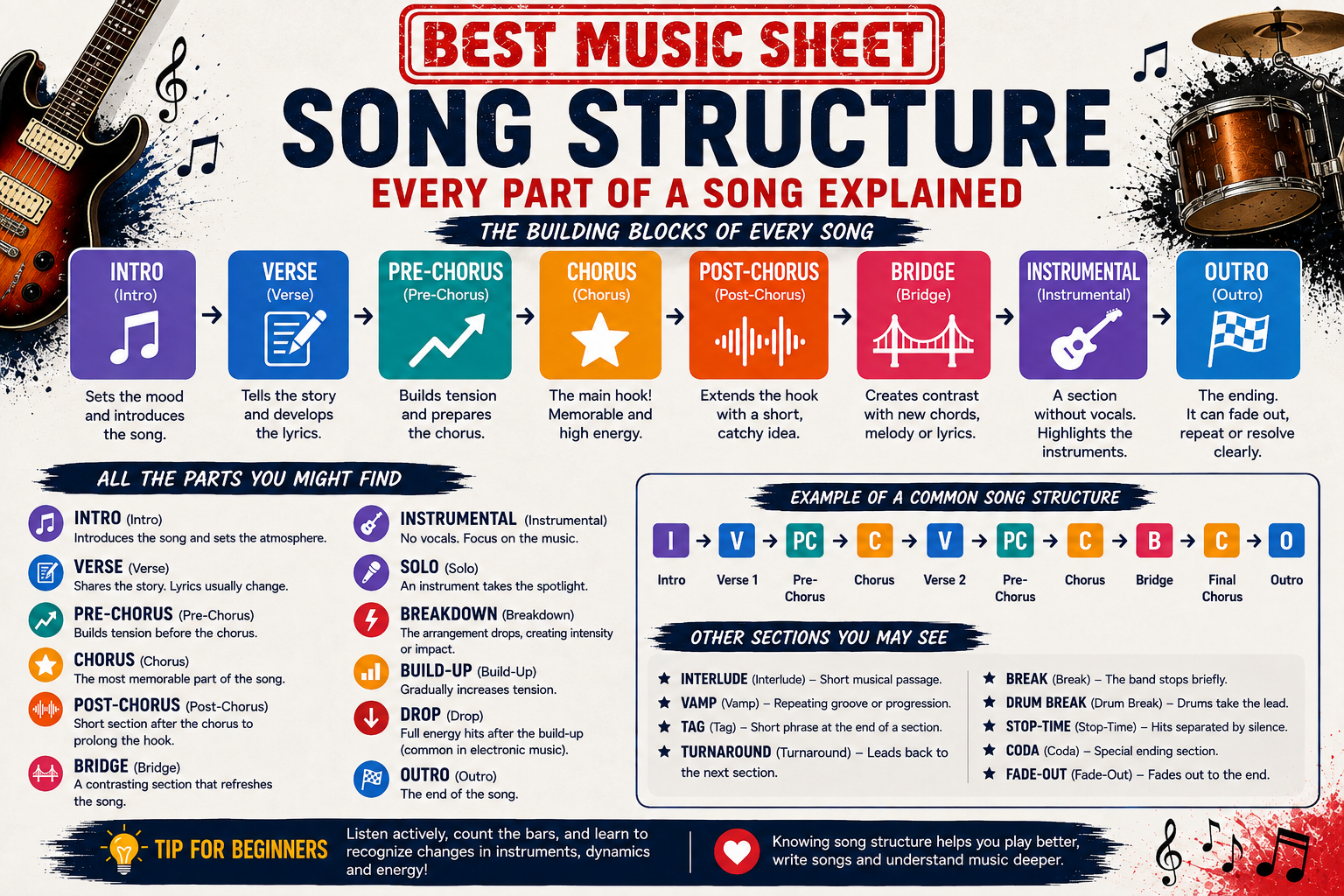
Verse, chorus, bridge, breakdown, intro, outro… Songs are built from sections, and each section has a specific musical role. This guide explains the most common — and some less common — song sections in simple terms, so beginner musicians can learn to recognise, play and understand them.
When you learn a song, you are not only memorising notes, chords or drum patterns. You are also learning its form: the order in which its different sections appear. Understanding form helps you remember songs faster, anticipate changes, rehearse efficiently and communicate with other musicians.
A typical pop/rock song at a glance
Verse 1→
Pre-Chorus→
Chorus→
Verse 2→
Pre-Chorus→
Chorus→
Bridge→
Instrumental→
Final Chorus→
Outro
There is no compulsory formula. A song can skip sections, repeat them, shorten them, combine them or use a completely different structure.
The main sections you will encounter
Intro
The intro is the beginning of the song. Its job is to establish the atmosphere before the main vocal or theme begins.
- It may present the main riff, chord progression or groove.
- It can be instrumental or contain a short vocal phrase.
- It often lasts 2, 4, 8 or 16 bars.
Verse
The verse usually develops the story or message of the song. The lyrics normally change from one verse to the next, while the music stays similar.
- Verse 1 introduces the situation.
- Verse 2 develops it.
- Later verses may add new details or intensify the story.
Pre-Chorus
The pre-chorus sits between the verse and chorus. It creates tension and makes the chorus feel more powerful when it arrives.
- The lyrics may repeat each time.
- The harmony, melody or rhythm often rises in intensity.
- Drummers may open the hi-hat, add fills or increase dynamics.
Chorus
The chorus is usually the most memorable section of the song. It often contains the main message, title or melodic hook.
- The lyrics usually stay the same each time.
- The arrangement is often fuller and louder.
- The melody is frequently more direct and memorable.
Post-Chorus
A post-chorus comes immediately after the chorus. It extends the hook without simply repeating the whole chorus.
- It may use a repeated vocal phrase such as “oh-oh” or a short lyric.
- It can feature an instrumental hook.
- It often keeps the energy high before returning to the verse.
Bridge
The bridge introduces contrast after the listener has heard the verse and chorus several times. It usually appears once, often near the final third of the song.
- New chords, melody, rhythm or lyrics.
- Often changes the emotional perspective.
- Frequently leads into the final chorus.
Solo
A solo puts one instrument in the foreground: guitar, saxophone, keyboard, drums, bass, etc.
- It may use the harmony of a verse or chorus.
- It may have its own dedicated chord progression.
- Other instruments usually support the soloist rather than compete with them.
Outro
The outro is the ending of the song. It can be a new section or a modified version of material heard earlier.
- Repeated chorus or riff.
- Gradual reduction of instruments.
- Final chord or dramatic stop.
- Fade-out.
Other sections and terms worth knowing
Instrumental
A section with no lead vocal. It may repeat a verse or chorus progression, present a riff, or provide space between sung sections.
Interlude
A short connecting section placed between two major sections. It can provide a pause, introduce a new texture or prepare the next part.
Breakdown
A section where the arrangement becomes simpler or more exposed. Instruments may drop out, leaving only drums, bass, vocals or a reduced groove. In rock, metal and electronic music, the term can describe a particularly heavy or rhythm-focused section.
Build / Build-Up
A section designed to increase tension gradually through dynamics, rhythm, rising notes, repeated figures, automation or added instruments. Common in pop and electronic music.
Drop
Common in electronic music. The drop is the high-impact section that arrives after a build-up, often introducing the main beat, bass line or instrumental hook.
Riff Section
A section organised around a repeated musical phrase, often played by guitar, bass, keyboards or the whole band. In rock and metal, a riff may be important enough to function almost like a chorus.
Refrain
A refrain is a repeated line or short passage. It is not always a full chorus. A song can have verses that end with the same refrain without having a separate chorus.
Hook
A hook is any especially memorable musical idea: a melody, lyric, riff, rhythm or sound. A hook is not necessarily a song section; it can appear inside a verse, chorus or instrumental passage.
Vamp
A short chord progression, groove or phrase repeated for an open or flexible amount of time. Vamps are common under solos, spoken introductions, audience interaction or live endings.
Tag
A short phrase repeated at the end of a section or song. A tag often repeats the final lyric, chord progression or hook several times before the ending.
Turnaround
A brief musical passage that leads back to the beginning of a section, often from the end of one verse to the next. Common in blues, jazz, country and many groove-based styles.
Transition
Any short passage that connects two sections. Drum fills, risers, breaks, cymbal crashes and harmonic changes often act as transitions.
Break
A brief moment where most or all instruments stop, often for one beat or one bar. Breaks create surprise, tension and rhythmic impact.
Stop-Time
A rhythmic device where the band plays short accents separated by silence while a singer or soloist continues. Common in blues, jazz, rock and funk.
Drum Break
A passage where the drums become the main focus, either alone or with very limited accompaniment. It may last only one bar or become a complete feature section.
Coda
Coda literally means “tail”. It is a specially written ending section that appears after the main form has finished. In notation, a coda can also be reached using a coda sign.
Cold Open
A song that begins immediately with vocals, the main riff or even the chorus, without a traditional intro.
Pickup / Anacrusis
One or more notes that occur before the first complete bar. A vocal or instrumental phrase may begin before beat 1.
Count-In
A spoken or played count before the performance starts — for example, “1, 2, 3, 4”. It establishes tempo and gives musicians a common starting point.
Final Chorus / Double Chorus
The final chorus is often expanded for extra impact. A double chorus simply means the chorus is played twice consecutively, sometimes with added harmonies, fills or ad-libs on the second pass.
Half-Time / Double-Time Section
The underlying pulse may feel twice as slow or twice as fast even though the actual tempo may not change. These changes can make a familiar section feel dramatically different.
Modulation Section
A section where the song changes key. Some pop songs raise the final chorus by a semitone or whole tone to create extra lift.
False Ending
The music appears to finish, then suddenly continues. This creates surprise and is common in live arrangements and some studio recordings.
Fade-Out
The music keeps repeating while the recording volume gradually decreases. The performance does not necessarily contain a written final ending.
Important: song sections are about function, not just sound
Two sections can use the same chords and even the same groove but have different functions. For example, a verse and a guitar solo may share the same harmony, yet one supports the story and the other gives space to an instrumentalist. When analysing a song, ask: What is this section doing in the overall journey of the song?
How musicians label song sections
In rehearsal charts and lead sheets, sections are often labelled with letters. This is especially useful when a piece does not follow standard verse/chorus terminology.
B = Chorus
C = Bridge
Possible form: Intro – A – B – A – B – C – B – Outro
But letters are not universal. In another arrangement, “A” may be the intro or main theme. Always check the chart or agree on terminology with the other musicians.
Quick reference table
| Section | Main function | What a beginner should listen for |
|---|---|---|
| Intro | Starts the song and establishes mood | First riff, groove or harmony before the main section |
| Verse | Develops the story | Changing lyrics with similar music |
| Pre-Chorus | Builds tension | Increasing intensity before the chorus |
| Chorus | Delivers the main hook | Repeated lyrics, title, strongest melody |
| Post-Chorus | Extends the hook | Short repeated phrase after the chorus |
| Bridge | Creates contrast | New harmony, melody or rhythm late in the song |
| Solo | Spotlights an instrument | Lead instrument improvises or plays a featured part |
| Instrumental | Creates a section without lead vocals | A riff, groove, melody or familiar chord progression played without the main vocal |
| Breakdown | Reduces or changes the texture | Fewer instruments, stronger rhythmic focus |
| Interlude | Connects sections | Short instrumental passage between main sections |
| Outro / Coda | Ends the song | Repeated final material, ending figure or fade |
Song Structure – Quick Reference
Download the complete infographic and keep it as a quick reference while learning or practising a song.